 CupClarityMy notebook
Hario Switch 02 vs 03: 200 ml vs 360 ml & Recipe Fit
Check the glass Switch model numbers, listed capacities and matching filters, then separate a held immersion stage from the total water in a hybrid recipe.
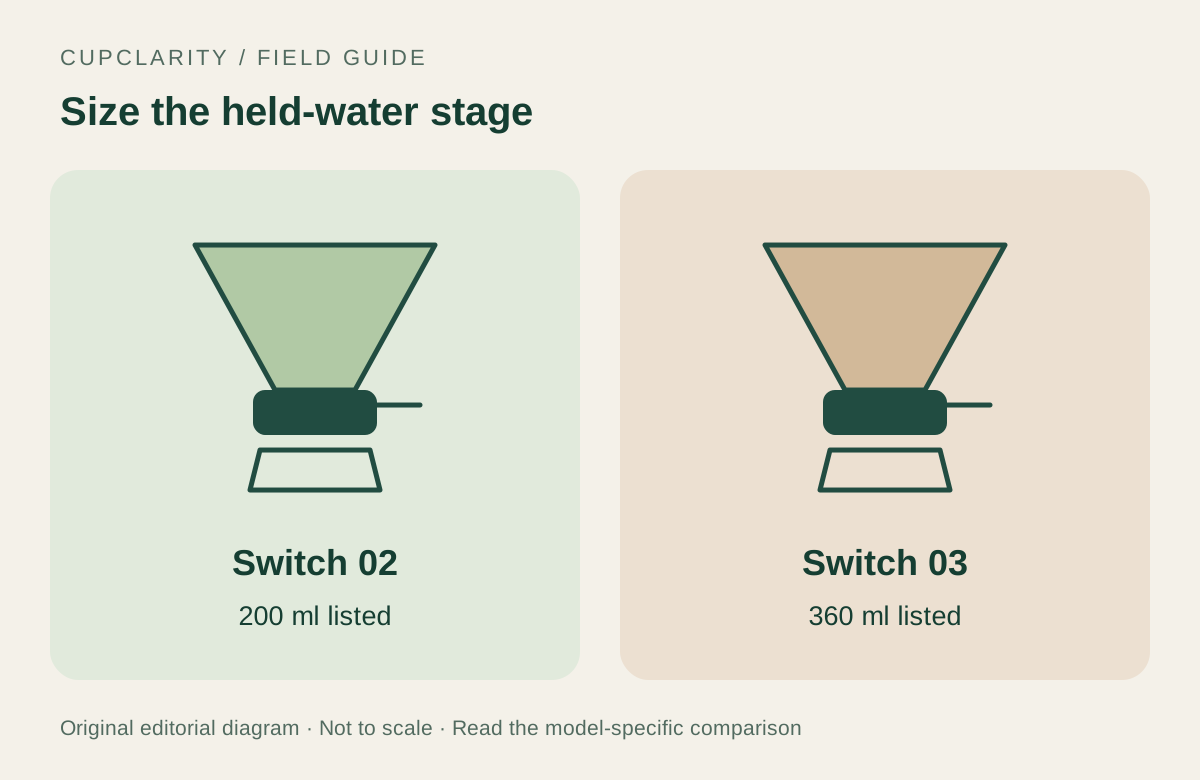
Sources checked October 21, 2026. This is a research-based comparison, not a hands-on test or taste ranking. Manufacturer facts are attributed; worked examples and decision worksheets are our editorial analysis. Illustrations are schematic, not photographs.
| Specification / decision | Glass Switch 02 | Glass Switch 03 |
|---|---|---|
| Listed model | SSD-200-B | SSD-360-B |
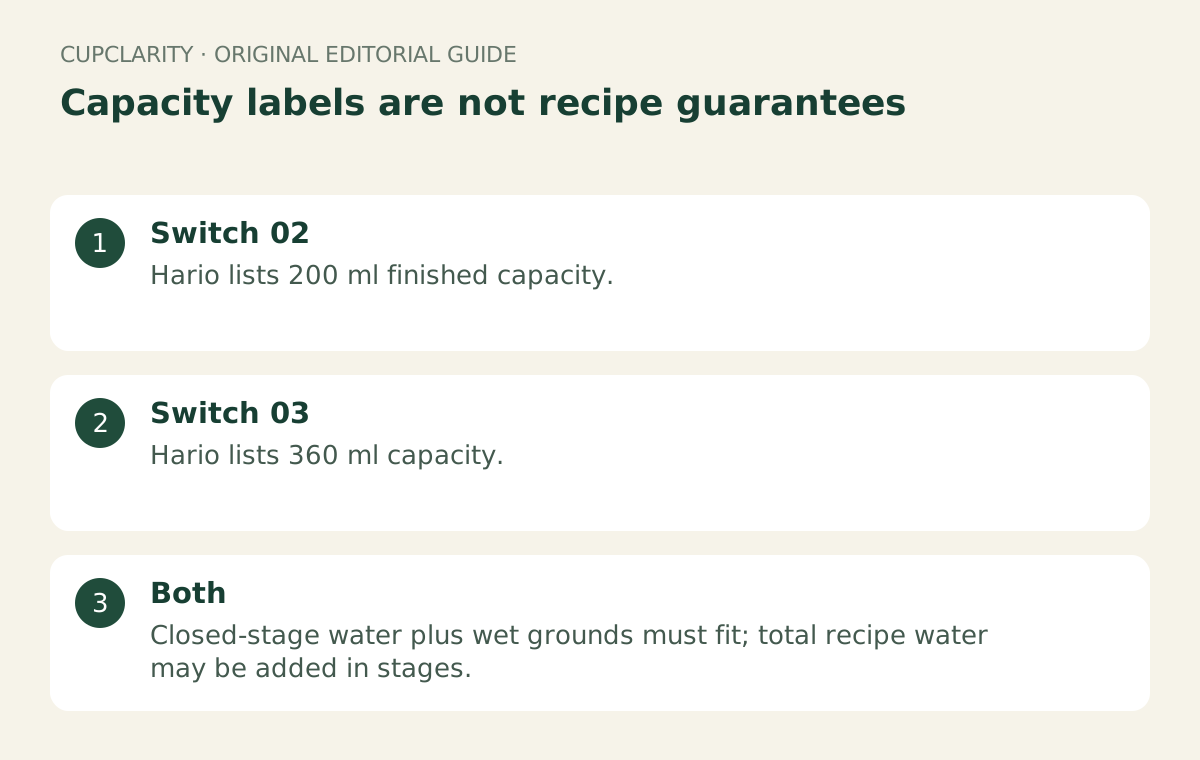
| HARIO USA capacity wording | Finished capacity: 200 ml | Dripper capacity: 360 ml |
| Matching paper size | V60 02 | V60 03 |
| Listed dimensions | 118 × 115 × 133 mm | 154 × 144 × 157 mm |
| Routine to check | Smaller held stage / serving | Larger held stage / serving |
| Not established by size | Taste, grind setting or best steep time | Taste, grind setting or best steep time |
Keep the product family precise
This comparison uses HARIO USA’s glass Switch listing, not every ceramic Switch & Match variation or third-party replacement cone. The page identifies SSD-200-B and SSD-360-B, provides dimensions and describes both immersion and standard pour-over use. Compare the model code in the listing you intend to buy. A photograph showing a black base is not enough to confirm size, supplied parts or compatibility.
Capacity is not the same as total recipe water
A closed-valve stage holds water and coffee together; an open-valve pour drains while more water is added. A hybrid recipe can therefore use more total water than is held at one moment. Do not choose a size by reading the final total alone. Write the recipe as stages, marking whether the valve is open or closed and how much water is added in each stage. That makes the largest held stage visible.
Leave room for the actual coffee bed
Ground coffee occupies space, and agitation requires practical headroom. The manufacturer’s capacity wording is not a recommendation to pour that volume onto every possible dose while the valve is closed. Follow the supplied instructions and stop before an unsafe fill level. If a recipe pushes the limits of the smaller model, choose a compatible smaller recipe or investigate the larger size rather than testing overflow with hot water.
One large mug and two small cups are different plans
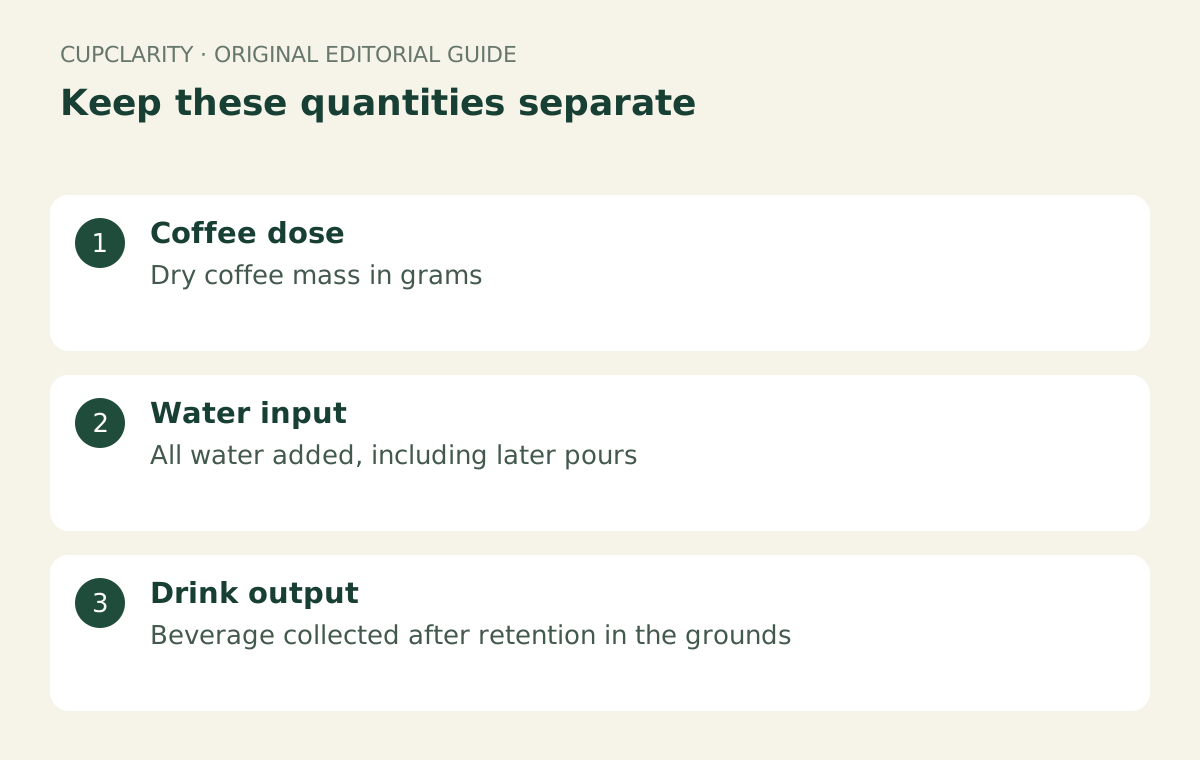
Measure the drink you want to serve. A nominal 360 ml capacity does not promise two full 240 ml mugs, and retained water means input and beverage output differ. If your household needs a larger total, compare multiple batches or a suitable pour-over workflow instead. For example, a recipe with 25 g coffee and 400 g total water has a 1:16 input ratio, but that arithmetic alone says nothing about whether its closed stage fits either cone.
Filters and receiving vessels belong in the shortlist
Match 02 or 03 papers to the selected cone, and check what is available where you normally shop. Place the brewer on a suitably stable receiver that can hold the finished batch. Compare base support, overall height under a shelf and the space required to operate the lever. These physical checks often settle a purchasing decision more reliably than a generic claim that bigger is more versatile.
Do not copy grind and timing blindly
If you move to a larger dose or change the immersion stage, record the new recipe from scratch. Use the same coffee for the first comparison and change one parameter at a time. A successful 02 recipe is useful background, not a guarantee of identical drawdown on a larger batch. Note whether the difference you care about is taste, serving quantity or less repeated work; those are separate goals.
Is the 03 always better for a hybrid recipe?
No. Break the recipe into stages first. An illustrative 300 g total could consist of 150 g poured with the valve open and allowed to drain, followed by a separate 150 g held stage. That is not equivalent to holding 300 g at once. This example explains bookkeeping only; it is not a tested Switch recipe. Use a published method appropriate to the exact model, with headroom and coffee displacement considered.
Our practical decision rule
Start with the exact recipe you intend to repeat. If its held stage fits the 02 comfortably and one serving meets your routine, the smaller model may be sufficient. If you specifically need more held-stage room, compare the 03’s footprint and paper supply. If you have not chosen between immersion and pour-over at all, make that decision first using the Switch-versus-V60 guide. Size alone is not a quality tier.
Check a hybrid recipe before scaling it
A hybrid recipe may release an early pour and then close the switch for a later immersion stage. Its total water input therefore does not describe the largest volume held in the closed dripper. Before scaling, identify the largest closed stage and allow room for the wet coffee bed and agitation. Keep the dripper over a stable vessel with enough capacity to receive the entire drink. If a recipe was developed for a different size, treat it as a starting point: grind, bed depth and drainage may need adjustment. The manufacturer's listed capacity alone cannot establish that a particular scaled recipe will fit safely.
How we research these guides · Find your next step