 CupClarity
A simple guide to coffee-to-water ratios
Leave the guesswork behind. Use a repeatable starting point, then adjust to your taste.
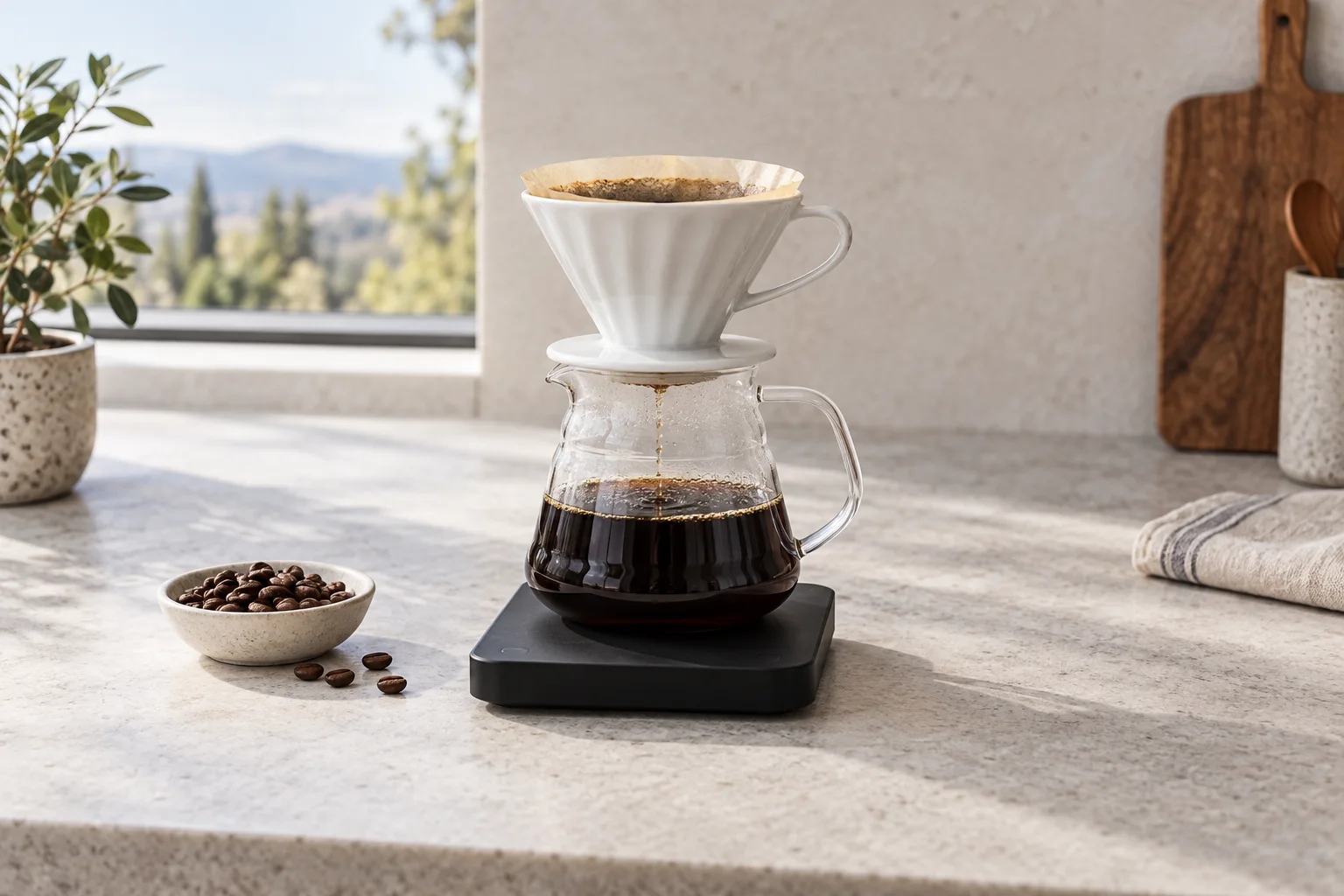
Original instructional worksheet and arithmetic examples, not a hands-on product test. Illustrative observations are labeled; use your own measurements in the downloadable record. No affiliate links.
Read a ratio as a recipe
A 1:16 ratio means one gram of coffee for every sixteen grams of brewing water. For 20 grams of coffee, that is 320 grams of water. It describes the water you add, not the final drink weight: some water stays in the grounds.
Try a starting point
For filter coffee, 1:16 is a useful experiment rather than a rule. Brew one cup, record the result and change only one variable next time. Espresso ratios use beverage yield and should not be interpreted the same way.
- 15 g coffee + 240 g water: a small brew.
- 20 g coffee + 320 g water: a larger brew.
- 30 g coffee + 480 g water: enough to share, depending on serving size.
Change strength deliberately
If the drink seems too concentrated, try a little more water relative to the same dose. If it seems weak, try less. Sourness and bitterness can also involve grind, temperature and extraction, so changing the ratio does not fix every problem.
Keep a short brewing note
Write down the bean, dose, water amount, grind setting and what you tasted. A few clear notes are more useful than changing every setting at once.
Calculate in either direction
To find brewing water, multiply dry coffee mass by the second number of the ratio: 18 g × 16 = 288 g of input water. To find coffee for a planned water amount, divide instead: 400 g ÷ 16 = 25 g of coffee. These examples explain the arithmetic; they are not a promise that 1:16 will be your preferred recipe for every bean or brewer.
Keep input water distinct from the finished drink
If you need a particular serving volume, make a measured trial and record the amount of coffee that reaches the cup. Do not assume 320 g poured into a brewer produces 320 g of beverage. For espresso, a ratio such as 1:2 normally compares dry dose with beverage output; changing the meaning of the second number changes the calculation. Label each column in your notes to prevent confusion.
Scaling changes the load on your equipment
Before doubling a recipe, check brewer capacity, the server and total load on the scale. Scaling 20 g and 320 g to 40 g and 640 g preserves the written ratio, but it does not prove that the same pouring pattern, filter or timing will work unchanged. Treat the larger brew as a new recipe to record rather than a tested equivalent.

