 CupClarityOur approach
 OutIn Fino grind settings: build a repeatable brew log
Turn the Fino’s adjustment dial into a useful brewing record, without treating an untested click chart as a guaranteed recipe.
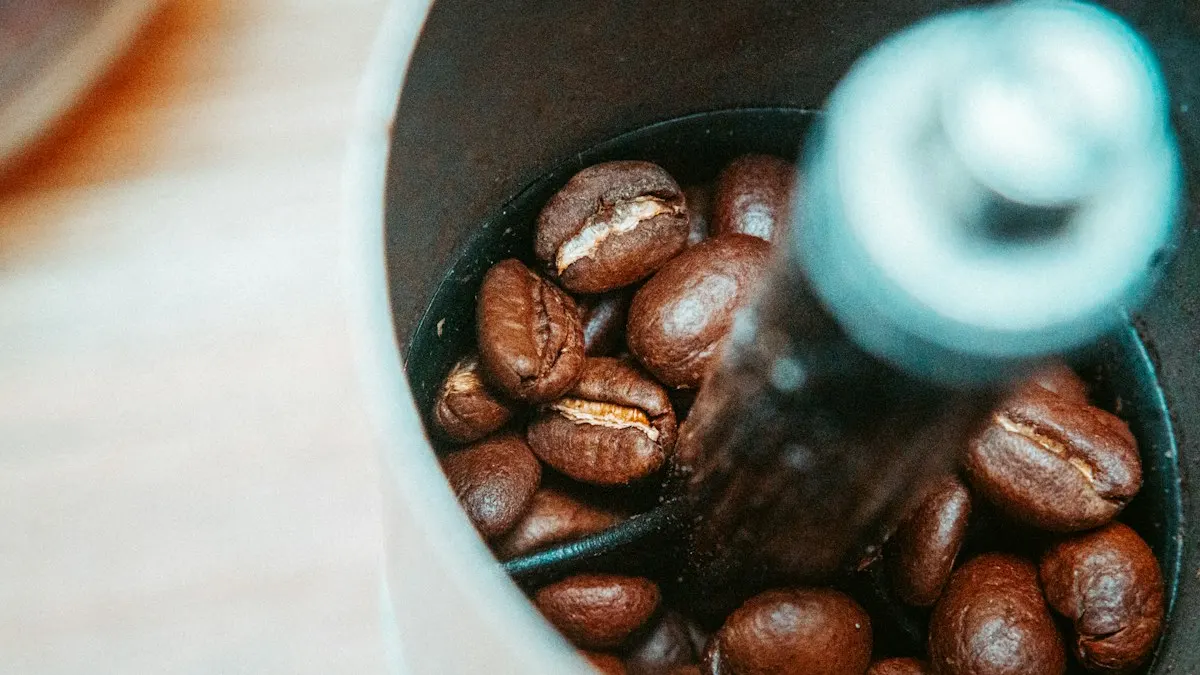
Research-based guide, checked September 21, 2026. We have not tested this product. Specifications are attributed to the linked manufacturer or listing; buying and brewing suggestions are our editorial analysis. The image is illustrative, not the reviewed product. Links are not affiliate links.
Start with the current instructions
OutIn announced a renewed go-to-market campaign for Fino on January 27, 2026. That is a dated promotion signal, not evidence of a new brand or a sales surge. Its current product page describes a cordless grinder with 28 marked levels and fine adjustment. This guide is a method for recording your own results; it is not a tested settings chart.
Record the dial exactly as you read it
Use the instructions supplied with your unit to identify its adjustment notation. Write the complete marking in your notebook and take a reference photograph before changing it. A number without the model and notation is difficult to reproduce later. Do not transfer a click count from a different grinder, and do not force an adjustment past its stated limits.
Create a baseline you can repeat
Begin with a recipe you already use and the manufacturer’s guidance for your brewer. Keep the beans, dose, water and preparation method stable for the first comparison. Record the charge condition as an observation, rather than assuming it explains any difference. If you are using a Nano or Mino, check the current Fino compatibility instructions: OutIn’s product page specifies a setting of 2-1 or higher for those brewers.
A notebook template for the first three brews
Copy the fields below into a notebook. Leave unknown measurements blank instead of inventing precision. Make your first brew the baseline, use the second for one small permitted adjustment, and use the third to repeat whichever result you preferred. This is a proposed experiment, not a recipe tested by CupClarity.
- Coffee and roast date; brewer and basket or filter.
- Dose in grams; water amount or beverage yield, with units.
- Full dial marking; charge condition; preparation method.
- Observed brew time; taste after a consistent cooling interval.
- Next change and the reason for making it.
Separate grind problems from recipe changes
If a brew behaves unexpectedly, check the recorded dose, assembly and preparation before changing several settings. A weak cup does not by itself identify a grind problem. For your next trial, choose one question: whether a small grind change helps, or whether a ratio change better matches your preferred strength. Keep the other variables steady so that the comparison has meaning.
What the notebook cannot establish
A few successful brews do not establish long-term durability, measured particle uniformity or suitability for every espresso machine. We have not tested those properties. If the grinder stalls or behaves abnormally, stop and follow its troubleshooting guidance rather than repeating a blocked cycle. Use the official FAQ for model-specific support; the Amazon link is a product reference, not a statement about current stock or seller quality.