 CupClarityMy notebook
Moka Pot vs French Press: Heat, Serving Size & Daily Use
Compare a stovetop brewing cycle with a steep-and-pour carafe. Start with the drink you want, then check heat compatibility, batch size and cleaning.
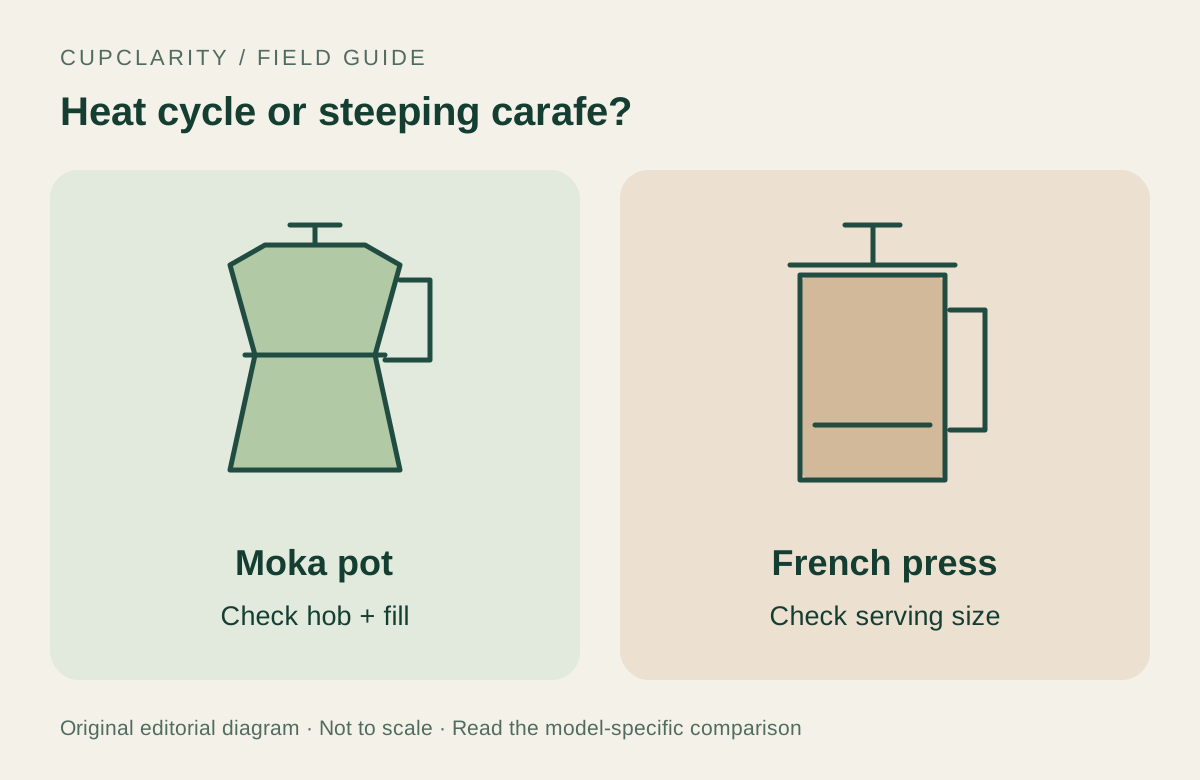
Sources checked October 21, 2026. This is a research-based comparison, not a hands-on test or taste ranking. Manufacturer facts are attributed; worked examples and decision worksheets are our editorial analysis. Illustrations are schematic, not photographs.
| Decision | Moka pot | French press |
|---|---|---|
| Heat workflow | Brewer sits on a compatible heat source | Hot water added to a separate carafe |
| Serving question | Check the specific pot’s output | Check usable carafe volume |
| Recipe flexibility | Respect boiler and basket instructions | Adjust a measured batch within capacity |
| Parts to inspect | Seal, funnel, filter and valve per manual | Carafe, plunger and mesh per manual |
| Serving with milk | Decide base volume before adding milk | Decide coffee-to-milk balance separately |
| Common mistake | Treating cup count as large mugs | Treating cup count as large mugs |
Choose the kind of routine before the hardware
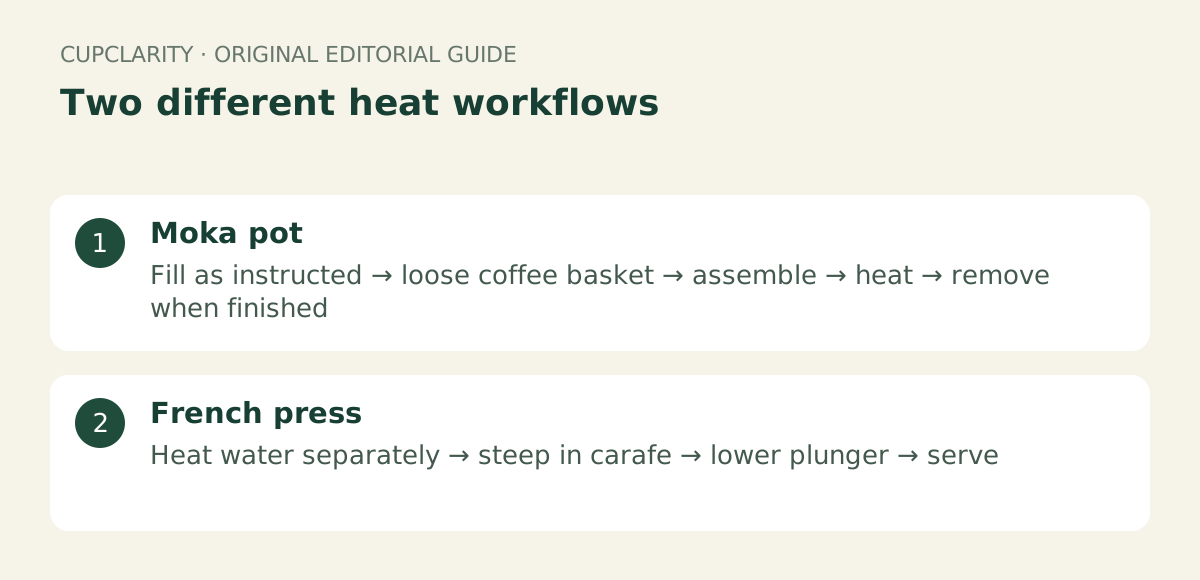
A moka pot makes coffee through a heating cycle on a suitable hob; a French press holds coffee and hot water while it steeps. Think about where you will brew. A desk with kettle access is a different setting from a kitchen with a compatible burner. The name stovetop espresso is not a reason to expect the same preparation as a pump espresso machine. This guide compares ownership and serving decisions, not measured pressure or taste.
Read the moka instructions as operating limits
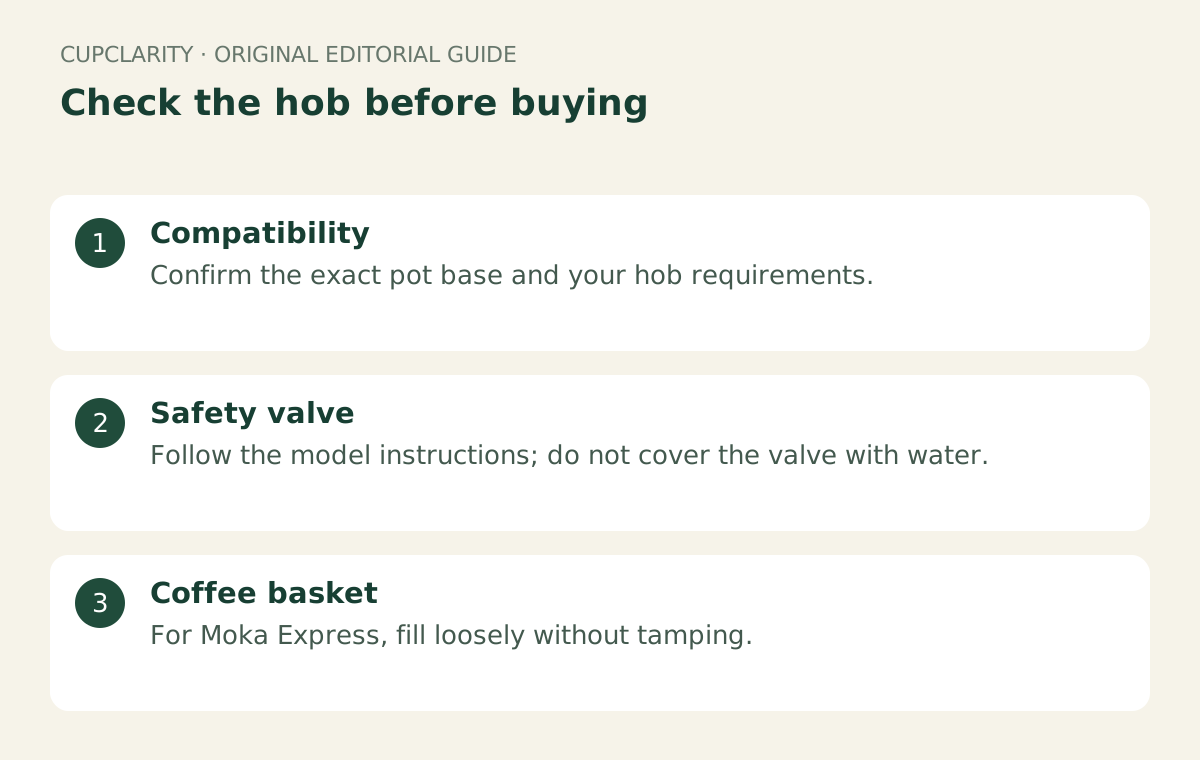
Bialetti instructs Moka Express users to keep water below the safety valve, load the funnel without pressing coffee down, and use low-to-medium heat. Those are operating instructions, not variables to override in pursuit of strength. Follow the manual for the actual model and heat source you own. Do not tamp, obstruct the valve, or assume a different material or model has the same hob compatibility. Let the pot cool before disassembly.
Translate cup counts into your own breakfast
Bodum’s published cup convention is about four ounces; a moka pot’s nominal cup count is a different serving convention. Before comparing two products, look for actual volume information and decide how much you drink. Record coffee served before milk or water is added. If you want one large milk drink, your desired coffee base may differ from someone serving several small black coffees. The number printed in the product title cannot resolve that distinction.
Do not scale a moka pot like a pour-over recipe
A moka pot’s boiler and basket are parts of its prescribed operating setup. Use the maker’s procedure rather than applying a generic 1:16 ratio or arbitrarily half-filling it to copy a French-press batch. For the press, record weighed coffee and water within its usable capacity and follow its brewing instructions. If you need a different routine volume, investigate the correct equipment size instead of assuming every brewer scales linearly.
Milk changes the comparison you are making
Compare the black coffee bases first if your question is about brewing. Then record the milk added to each final drink. Two cups with equal final volume can contain very different amounts of coffee and milk. A hypothetical 80 ml base plus 160 ml milk and 160 ml coffee plus 80 ml milk both total 240 ml, but the comparison is no longer simply moka versus press. Use that worksheet to describe what you actually enjoy.
Cleaning matters after the first week
A moka pot has a seal, funnel and other components whose condition and cleaning are covered by the model’s manual. A French press has wet grounds and a mesh assembly to clean. Check replacement parts before purchasing, especially for a secondhand brewer. Do not generalize dishwasher instructions across aluminum, stainless steel, glass or plastic products. Set aside a realistic place for rinsed parts to dry rather than storing them wet just to make the kitchen look tidy.
Which one should replace a broken brewer?
List the reason the old setup failed before shopping: damaged glass, a missing seal, poor heat compatibility or an unsuitable serving size. The repair or replacement decision is model-specific. If you need a new brewer, compare the cost of the whole working setup, including a suitable heat source or kettle and any replacement parts you expect to need. Do not compare only the two product prices while omitting equipment one method requires.
A useful shortlist for two different homes
For a kitchen routine built around small coffee servings and an appropriate hob, a moka pot is worth investigating. For a shared steep-and-pour carafe with kettle access, a French press may fit better. Neither choice removes the need to check size and care. If you already have a working brewer, identify the specific problem—serving volume, cleanup or drink style—before replacing it with a different method.
Treat the stove as part of the equipment
A moka pot comparison is incomplete without the hob. Check whether the exact model supports induction and whether its base matches your cooking surface requirements. Follow that model's instructions for water level, assembly and heat; a general coffee ratio should not override the safety guidance. Do not force a smaller serving by improvising a partially filled basket unless the manufacturer provides a suitable method. A French press uses separately heated water and has a different set of capacity and heat-handling constraints. Compare actual serving needs and the complete routine rather than interpreting moka cup labels as equivalent to full mugs.
How we research these guides · Find your next step